Higher Ed Law – Part Two:
Due Process, Student Conduct, and Decision-Making
Course ID: SA108
Title: Higher Ed Law – Part Two: Due Process, Student Conduct, and Decision-Making
Date: Tuesday, November 17, 2026
Time: 1pm EST (lasts approx. 1 hour)
Facilitators: Dr. Tara K. Shollenberger & Dr. Jordan Widelock
Price: $75

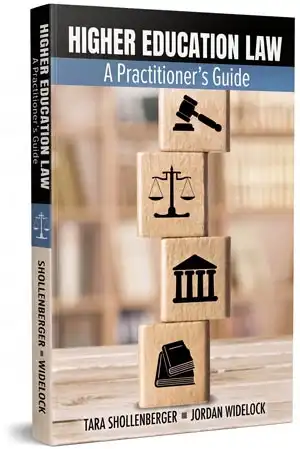 This four-part webinar series introduces student affairs professionals to the legal issues most likely to shape their daily work with students, families, student organizations, campus partners, and institutional leaders. Grounded in Higher Education Law: A Practitioner's Guide, the series translates complex legal principles into practical frameworks for campus decision-making. Each session is designed to help participants recognize common legal risks, ask better questions, and respond to student affairs scenarios with greater confidence and clarity.
Each session in this series is priced at $75. But you can take advantage of our volume discount by registering for more than one at one time. Save 10% on two items, 15% on three, and 20% on all four.
Part 1: Free Speech, Campus Expression, and Institutional Response
↠ Part 2: Due Process, Student Conduct, and Decision-Making (Tuesday, Nov. 17) [SA108]
Part 3: Student Privacy, Information Sharing, and Campus Safety (Tuesday, Jan. 19) [SA109]
Part 4: Disability, Accommodations, and Student Well-Being (Tuesday, Feb. 16) [SA110]
OVERVIEW
Due process is one of the most frequently misunderstood concepts in student affairs. Practitioners often treat it as a formality or procedural checklist without understanding the constitutional doctrine that defines what is actually required.
This webinar provides a practitioner-focused grounding in due process as it applies to student disciplinary proceedings, academic dismissals, interim actions, and institutional decision-making under time pressure.
BRIEF OUTLINE
- Constitutional grounding: the Fourteenth Amendment and state action
- Disciplinary vs. academic dismissal: different standards and obligations
- Dixon, Goss, and Mathews as the doctrinal foundation
- Notice, hearings, adviser access, and attorney access
- Interim suspension and emergency decision-making
- Auditing conduct policies for procedural vulnerabilities
LEARNING OUTCOMES
- Explain the constitutional basis for due process in public higher education.
- Distinguish between procedural expectations for disciplinary and academic decisions.
- Apply the Mathews balancing framework to evaluate the adequacy of institutional process.
- Identify common notice, hearing, adviser, and interim suspension concerns.
- Audit student conduct processes for recurring due process vulnerabilities.
WHO SHOULD ATTEND:
Student conduct administrators, dean of students staff, housing and residential life directors, Title IX coordinators and investigators, academic affairs administrators involved in academic integrity or dismissal decisions, and any student affairs professional who participates in institutional hearings or disciplinary decisions. Particularly relevant for those who are new to conduct work or who are transitioning into senior conduct or administrative roles.
 Dr. Tara K. Shollenberger is an Assistant Professor of Educational Studies at High Point University, where she teaches higher education law at the doctoral level, and co-author of Higher Education Law: A Practitioner's Guide (Kendall Hunt, 2024). She brings more than 20 years of higher education experience to this work, including her last role as Assistant Vice President for Student Life. She is an active scholar and presenter, with peer-reviewed publications and conference presentations at ASCA, NASPA, and NABITA. Dr. Shollenberger serves on the NABITA Advisory Board and consults with institutions on student conduct, threat assessment, and Title IX policy and compliance.
 Dr. Jordan Widelock is an Assistant Professor and Chair of the Educator Preparation Department in the Stout School of Education at High Point University. A former teacher, instructional coach, and school administrator, he brings a practitioner's lens to questions of education law, policy, leadership, and institutional decision-making. He holds both a J.D. and an Ed.D. in Educational Leadership and is co-author of Higher Education Law: A Practitioner's Guide (Kendall Hunt, 2024). His scholarship and authored work examine legal and policy issues affecting schools, universities, educators, and students, including institutional liability, duty of care, student rights, and the legal responsibilities of educational institutions. His work focuses on helping educators and campus leaders understand complex legal issues in ways that are practical, accessible, and grounded in real institutional contexts.
» See also Higher Ed Law Series Part 1 • Part 2 • Part 3 • Part 4
Registrants will be notified the day before the event with ZOOM login details. Later registrations will be notified manually once we receive them. Registrations just before the event launch will also be notified manually as soon as possible.
For volume pricing for this single live webinar, email staff@mystudentaffairs.com with your request so we can send you a special Paypal invoice.

» All LIVE webinars on our home page
» View Replay Library